
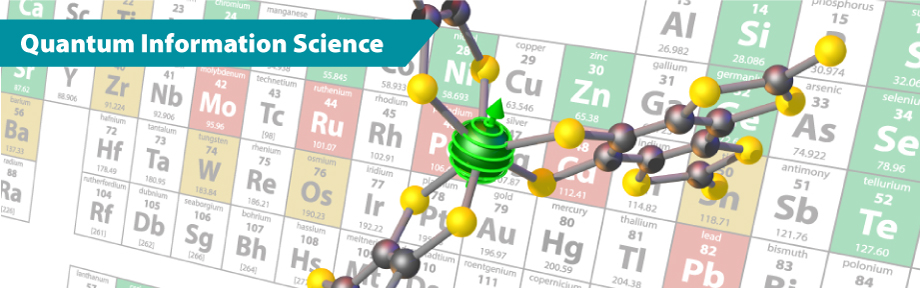
A molecular approach to quantum information science
We are living in the second quantum revolution, a time where we are beginning to harness our control of the quantum nature of the universe. Within this broad manifold of quantum information science, new quantum technologies spanning computation, communications, sensing, and metrology are revolutionizing disparate fields ranging from mechanistic biology to condensed matter physics. To address the breadth of challenges across these disciplines, the information processing platforms of these technologies will require materials that are reliably tunable, readily scalable, and translatable across device architectures. In the Freedman lab, we design the units of quantum information science, known as qubits, using the electron spin of paramagnetic coordination complexes. Our lab uses synthetic inorganic chemistry combined with ligand field theory to provide methodologies to both tune the overall electronic structure and introduce valuable new features within our qubits. These coordination complexes are then powerful vessels to explore the interplay of optical and magnetic properties, to construct spin-based frameworks, and to engineer coherent spin-spin interactions. In our lab, we measure their structural, magnetic, and optical properties to inspire the next generation of molecular components within quantum technologies.
Select Publications
Spectral Addressability in a Modular Two Qubit System
von Kugelgen, S. W.; Krzyaniak, M. D.; Gu, M.; Puggioni, D.; Rondinelli, J. M.; Wasielewski, M. R.; Freedman, D. E. J. Am. Chem. Soc. 2021, 143, 8069-8077.
Optically Addressable Molecular Spins for Quantum Information Processing
Bayliss, S. L.; Laorenza, D. W.; Mintun, P. J.; Kovos, B. D.; Freedman, D. E.; Awschalom, D. D. Science 2020, 370, 1309-1312.
Nickel(II) Metal Complexes as Optically Addressable Qubit Candidates
Wojnar, M. K.; Laorenza, D. W.; Schaller, R. D.; Freedman, D. E. J. Am. Chem. Soc. 2020, 142, 14826-14830.
A Concentrated Array of Copper Porphyrin Candidate Qubits
Yu, C.-J.; Krzyaniak, M. D.; Fataftah, M. S.; Wasielewski, M. R.; Freedman, D. E. Chem. Sci. 2019, 10, 1702-1708


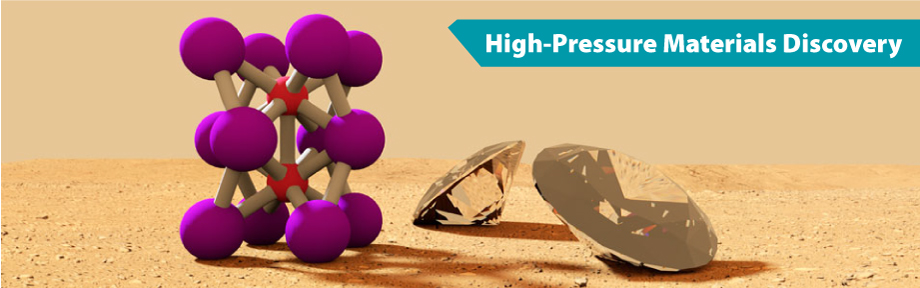
Extreme pressure as a synthetic vector
Spin-orbit coupling is the critical element underlying phenomena ranging from permanent magnetism to topologically non-trivial ground states. To imbue materials with spin-orbit coupling, we take elements featuring large amounts of spin-orbit coupling but no spin, such as bismuth, and build them into materials featuring a property of interest such as spin or conductive electrons. This approach enables us to rationally perturb the properties of a material by incorporation of spin-orbit coupling. In these new materials spin-orbit coupling can combine with unpaired electronic spin to enforce high magnetoanisotropy, split electronic bands to make topological insulators, and even give rise to unconventional high-temperature superconductivity. Creating new materials requires expanding accessible synthetic space. We employ pressure as a synthetic vector to realize new materials within underexplored synthetic spaces. Using diamond anvil cells as tiny transparent high-pressure reaction vessels, our lab discovered the first compound, FeBi2, in the iron–bismuth chemical system, combining the unpaired spins of iron with the spin-orbit coupling of bismuth into a candidate ferromagnet. Further, we are leveraging the transparency of diamond to a wide range of electromagnetic radiation to characterize the magnetic, superconducting, and electronic properties of new high-pressure quantum materials including BiVO3, FeBi2, and MnBi2 in situ. The synthesis and characterization of these novel materials feed back into designing the next generation of topological, magnetic, and superconducting materials.
Select Publications
Computationally Directed Discovery of MoBi2
Altman, A. B.; Tamerius, A. D.; Koocher, N. Z.; Meng, Y.; Pickard, C.; Walsh, J. P. S.; Rondinelli, J. M.; Jacobsen, S. D.; Freedman, D. E. J. Am. Chem. Soc. 2021, 143, 214-222.
Controlling Dimensionality in the Ni–Bi System with Pressure
Clarke, S. M.; Powderly, K. M.; Walsh, J. P. S.; Yu, T.; Wang, Y.; Meng; Y.; Jacobsen, S. D.; Freedman, D. E. Chem. Mater. 2019, 31, 955-959.
MnBi2: A Metastable High-Pressure Phase in the Mn–Bi System
Walsh, J. P. S.; Clarke, S. M.; Puggioni, D.; Tamerius, A. D.; Meng, Y.; Rondinelli, J. M.; Jacobsen, S. D.; Freedman, D. E. Chem. Mater. 2019, 31, 3083–3088.
High-Pressure Synthesis of the BiVO3 Perovskite
Klein, R. A.; Altman, A. B.; Saballos, R. J.; Walsh, J. P. S.; Tamerius, A. D.; Meng, Y.; Puggioni, D.; Jacobsen, S. D.; Rondinelli, J. M.; Freedman, D. E. Phys. Rev. Mater. 2019, 3, 64411.


Chemical approaches to emergent properties
Targeted synthetic approaches can lead to fundamentally new materials that display exotic spin physics. For example, the synthesis of systems with spin-bearing ions arranged on a perfect triangular lattice is one route toward a bulk state known as a spin liquid. Candidate systems sometimes appear in nature, or through serendipitous discovery, but guided by physicists we should be able to judiciously design and isolate systems with the required properties. We are targeting new materials in this way, using unconventional approaches toward synthesis, to create new materials that will help us to answer outstanding questions in magnetism, superconductivity, and condensed matter physics.
Select Publications
Pressure-Induced Collapse of Magnetic Order in Jarosite
Klein, R. A.; Walsh, J. P. S.; Clarke, S. M.; Liu, Z.; Alp E. E.; Bi W.; Meng, Y.; Altman, A. B.; Chow, P.; Xiao, Y.; Norman, M. R.; Rondinelli, J. M.; Jacobsen, S. D.; Puggioni, D.; Freedman, D. E. Phys. Rev. Lett. 2020, 125, 077202.
Synthetic Investigation of Competing Magnetic Interactions in 2D Metal–Chloranilate Radical Frameworks
Collins, K. A.; Saballos, R. J.; Fataftah, M. S.; Puggioni, D.; Rondinelli, J. M.; Freedman, D. E. Chem. Sci. 2020, 11, 5922-5928.
Impact of Pressure on Magnetic Order in Jarosite
Klein, R. A.; Walsh, J. P. S.; Clarke, S. M.; Guo Y.; Bi W.; Fabbris G.; Meng, Y.; Haskel D.; Alp E. E.; Van Duyne R. P.; Jacobsen, S. D.; Freedman, D. E. J. Am. Chem. Soc. 2018, 140, 12001-12009.
